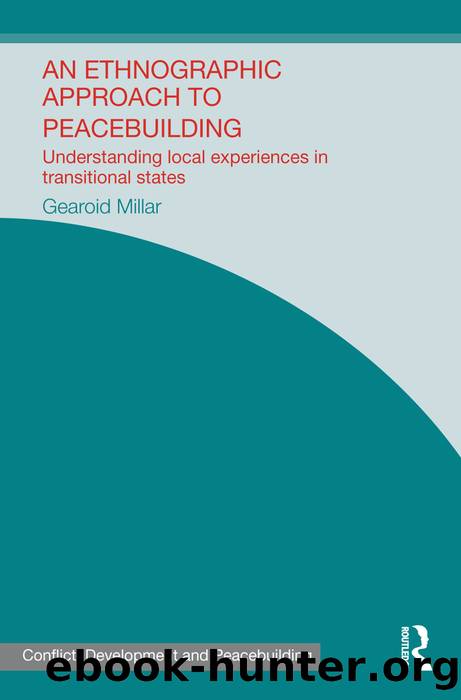
An Ethnographic Approach to Peacebuilding: Understanding Local Experiences in Transitional States by Gearoid Millar
Author:Gearoid Millar [Millar, Gearoid]
Language: eng
Format: epub
Tags: Africa, Peace, Political Science, Political Freedom, History, General
ISBN: 9781136011207
Google: KRFxAwAAQBAJ
Goodreads: 22147543
Publisher: Routledge
Published: 2014-04-24T00:00:00+00:00
Part III
The details and challenges of incorporating the ethnographic approach
7
The challenges and limitations of the ethnographic approach
The vast majority of peacebuilding work has and will continue to be conducted in settings of violence, poverty, disease, and hardship. However, most of the people who are today conducting evaluations of peacebuilding projects are academics, staff members of NGOs and funding agencies, consultants, and other predominantly Western expatriates, all of whom are ever more disciplined and professionalized to think and act in a particularly technocratic, solution-oriented mode; this, after all, is the point of training and professionalization. Most such evaluators have scant local knowledge and are instead, as Autesserre (2014) describes, hired for their technical training and professional proficiency. In addition, most of these professionals have little desire to spend six months or more of their lives in uncomfortable and potentially dangerous transitional states. These are some of the reasons so much evaluation consists of desk research, quantitative analysis, checklists, surveys, and perhaps a short âfield trip.â Spending time in an impoverished post-conflict setting, and asking local non-elites what they are experiencing can be an arduous, exhausting, frustrating, and difficult task.
While some peacebuilding work is conducted in relatively developed settings such as Northern Ireland, the Former Yugoslavia, or the Basque Country, the majority of contemporary conflicts, and therefore, contemporary peacebuilding processes, occur in states such as Afghanistan, Iraq, Angola, Nicaragua, Peru, Haiti, Nepal, East Timor, the Democratic Republic of Congo, Sierra Leone, and Liberia, just to name a few. In the near future, peacebuilding projects will begin (or continue) in the countries of the Arab Spring such as Egypt, Libya, and Syria, as well as in Colombia, Myanmar, Sudan, Somalia, and Mali, and in the coming years peacebuilding processes are likely to occur within the many potential settings of state fragility and failure, among and within states torn apart by resource wars, environmental conflicts, distributional inequalities, and conflicts driven by dynamics we cannot yet even predict. Peacebuilding itself, and the process of conducting ethnographic evaluations of peacebuilding processes, will not get easier, and those who make the decision to commit to this form of evaluation must, without doubt, be prepared to deal with unpredictable and often dangerous fieldwork conditions. Therefore, as much as the ethnographic approach to evaluating peacebuilding intervention is necessary in complex, sensitive, and culturally variable transitional settings, it is also hampered by the very sensitivity of such settings (Bush and Duggan 2013b: 6â7).
This chapter is divided into three main sections which try to address some of these challenges with illustrations and reflections from my own fieldwork. The first and longest section describes the practicalities of dealing with challenges to oneâs own physical safety and security in transitional settings often characterized by high rates of disease, crime, and violence. The second section attempts to address the psychological challenges of working with and among marginalized populations often suffering from poverty, illiteracy, and hardship. Both of these sections will provide practical suggestions on how to avoid threats to oneâs physical safety and how to manage threats to psychological security.
Download
This site does not store any files on its server. We only index and link to content provided by other sites. Please contact the content providers to delete copyright contents if any and email us, we'll remove relevant links or contents immediately.
| Anthropology | Archaeology |
| Philosophy | Politics & Government |
| Social Sciences | Sociology |
| Women's Studies |
The Secret History by Donna Tartt(19086)
The Social Justice Warrior Handbook by Lisa De Pasquale(12190)
Thirteen Reasons Why by Jay Asher(8909)
This Is How You Lose Her by Junot Diaz(6886)
Weapons of Math Destruction by Cathy O'Neil(6279)
Zero to One by Peter Thiel(5801)
Beartown by Fredrik Backman(5754)
The Myth of the Strong Leader by Archie Brown(5507)
The Fire Next Time by James Baldwin(5442)
How Democracies Die by Steven Levitsky & Daniel Ziblatt(5218)
Promise Me, Dad by Joe Biden(5153)
Stone's Rules by Roger Stone(5087)
A Higher Loyalty: Truth, Lies, and Leadership by James Comey(4962)
100 Deadly Skills by Clint Emerson(4925)
Rise and Kill First by Ronen Bergman(4788)
Secrecy World by Jake Bernstein(4753)
The David Icke Guide to the Global Conspiracy (and how to end it) by David Icke(4717)
The Farm by Tom Rob Smith(4507)
The Doomsday Machine by Daniel Ellsberg(4490)
